Somewhere on a union printed piece there is a small oval mark, usually tucked along an edge or in a footer. Printers call it the union bug. If you buy print for a local, a council, a political committee or a signatory contractor, that mark is probably the reason somebody told you the job has to go to a union shop.
This is what the bug actually is, who needs one, and what to confirm before a run goes to press. Carroll Printing & Promotions has been printing in Houston since 1921 and is the Gulf Coast’s oldest Union printing company, so it is a question we field constantly.
What Makes a Printer a Union Printer
A union printer is a shop whose production work is performed by union labor under a union agreement. The distinction is about how the work is staffed and produced, not about the equipment in the building or the quality of the finished piece. Two shops can own the same press and only one of them can produce union work.
That is the whole reason the requirement exists in the first place. When a labor organization buys print, it is spending members’ money, and placing that spend with a union shop keeps it inside the same economy the members belong to. When a political campaign buys print, the same logic applies with an audience attached.
What the Union Bug Is, and What It Is Doing on Your Print Job
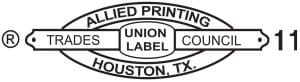 The union label is the small mark printed on a finished piece to show it was produced by union labor in a union shop. Most people in print call it the bug. You will usually find it tucked along an edge, in a footer, or near the fold, and it is deliberately small. The one shown here is the Allied Printing Trades Council label for Houston, Texas.
Small does not mean unimportant. For a lot of recipients it is the first thing they look for, and its absence on a piece that should carry it is noticed quickly. A few things are worth knowing:
- It is earned, not applied: a label is only legitimate on work genuinely produced under the relevant union’s terms. It is not a graphic that can be dropped into a layout by whoever is building the file. A piece carrying a bug it did not earn is a real problem, not a cosmetic one.
- Which label applies depends on the job: do not assume. Ask your printer to confirm exactly what will appear on your specific run, and get that confirmed before the job goes to press rather than after.
- Placement is a layout decision: if a committee needs to approve where the label sits, or the piece has a tight design that leaves nowhere obvious for it, raise that at proof stage. Moving it later means another proof cycle.
The question buyers ask next is what happens if a piece that needed a bug goes out without one. In practice it is not the printer who finds out. It is the person who signed off on the job, usually after the run is already delivered and somebody on the committee or the executive board notices. At that point the options are all bad: reprint at your own cost, distribute anyway and absorb the complaint, or explain it. Occasionally a piece is rejected outright and has to be produced again to meet the requirement.
All of that is avoidable by asking one question before the job goes to press. Confirm in writing that your piece will carry the label, and confirm which label it will be.
Who Actually Needs Union Printing
In practice the requirement turns up in four places:
- Labor organizations: locals and councils buying member communications, meeting notices, event materials and branded apparel and promotional items. For many of them the requirement is written into their own bylaws.
- Political campaigns: candidates and committees whose printed materials will be seen by union households, and who often face an explicit sourcing rule from endorsing organizations.
- Signatory contractors and employers: companies operating under collective agreements whose printed and branded materials are expected to match.
- Public and institutional buyers: organizations with procurement policies that favor or require union production.
If any of those describe you, the question is not really whether you need a union printer. It is whether the printer you are already using is one.
What a Campaign Print Program Usually Contains
A campaign rarely orders one thing. A typical program pulls together most of the following, and the pieces work better when they are planned as one job rather than four:
- Yard signs and rally signs: the most visible item in the program and the one voters associate with a campaign’s presence, and the case for putting real budget behind yard signs is worth reading.
- Banners and decals: wall banners and pop-up banners for offices and events, produced alongside other decals, banners and signs.
- Push cards and mailers: the workhorses of voter outreach, cheap enough to repeat through a cycle.
- Contribution and reply envelopes: the actual response mechanism, and the piece most often designed last when it should be designed first.
- Letterhead and thank you notes: correspondence going out over a candidate’s or an officer’s name, produced to the same standard as any other commercial printing job.
- Apparel, buttons and pins: the takeaways that turn supporters into visible ones.
If you are weighing how much of a campaign budget print deserves, we have covered what printed materials actually do for an election campaign and how the right print program strengthens a campaign in more depth.
Recent Campaign Work From Our Shop
Two examples of campaign print we produced, shown as they came off the job. Both were printed union at our shop on Canal Street.
 Banner, poster and a two sided flyer produced as one matched set for a state party chair campaign. Printing the whole set together is what keeps the color consistent across a banner, a poster and a flyer that are all made on different stock.
 A fold over push card for a Harris County judicial campaign, shown outside and inside. The fold is the point: it keeps the card small enough to hand out and still leaves room inside for the full platform. This is the kind of format decision worth making with your printer before the artwork is finished, not after.
Direct Mail Is Where Campaigns Lose Time
Of everything on that list, direct mail is the piece that most often goes wrong, and it rarely goes wrong at the press. It goes wrong because a mail job is four things that all have to agree: a printed piece, a list, a postal format and a date it has to land.
Change any one of them late and the other three move. A piece designed without the mail format in mind can turn out to be the wrong size or weight for the rate the campaign budgeted. A list that arrives a week late pushes the drop date past the moment the message mattered.
The fix is unglamorous: bring the mail plan to the printer at the same time as the artwork, not after the artwork is approved. Send the piece, the quantity, the list and the date it has to land, and the schedule can be built backwards from there.
Questions Worth Asking Any Union Printer
If you are shopping for union bug printing, these are the five questions worth asking before you place a run. A shop that does this work regularly will answer all of them without hesitating:
- What label will appear on my piece: the specific answer, confirmed for your job, not a general reassurance.
- Where will it sit: and can I see it on the proof.
- Can you produce the whole program: print, signage, mail and apparel, or only part of it.
- Can you handle the mail as well as the print: and what do you need from me to build the schedule.
- What do you need from me, and when: artwork, list, quantity and the date it lands.
FAQ’s for Union Printing and the Union Bug
Q: What is the union bug on a printed piece?
A: It is the small union label showing the piece was produced by union labor in a union shop, usually set along an edge or in a footer. It is only legitimate on work actually produced under the relevant union’s terms, so it cannot simply be added to artwork.
Q: Does a union printer cost more?
A: Send us the piece, the quantity and the schedule and we will quote it. Pricing depends on the specifics of the run, so anyone quoting you a rule of thumb without seeing the job is guessing.
Q: Do I need union printing if my organization is not a union?
A: Not necessarily, but check your own requirements first. Political committees, endorsing organizations and some public buyers apply the rule even when the purchaser is not itself a labor organization.
Q: Can you produce campaign apparel as well as print?
A: Yes. Caps, shirts, buttons, pens and lapel pins are produced alongside the print, which keeps the branding consistent across the whole program.
Q: Do you only work with campaigns in Houston?
A: No. We serve Greater Houston and the Gulf Coast directly, and produce union printing, campaign materials and direct mail for labor organizations and campaigns nationwide.
Carroll Printing & Promotions has been printing in Houston since 1921 and is the Gulf Coast’s oldest Union printing company. If you have a campaign program, a member mailing or a print run with a union requirement attached, see our union and political printing page, call 713-228-9331, or request a quote and tell us the piece, the quantity and the date it has to land. Our printing and apparel FAQs cover the questions that come up most often.